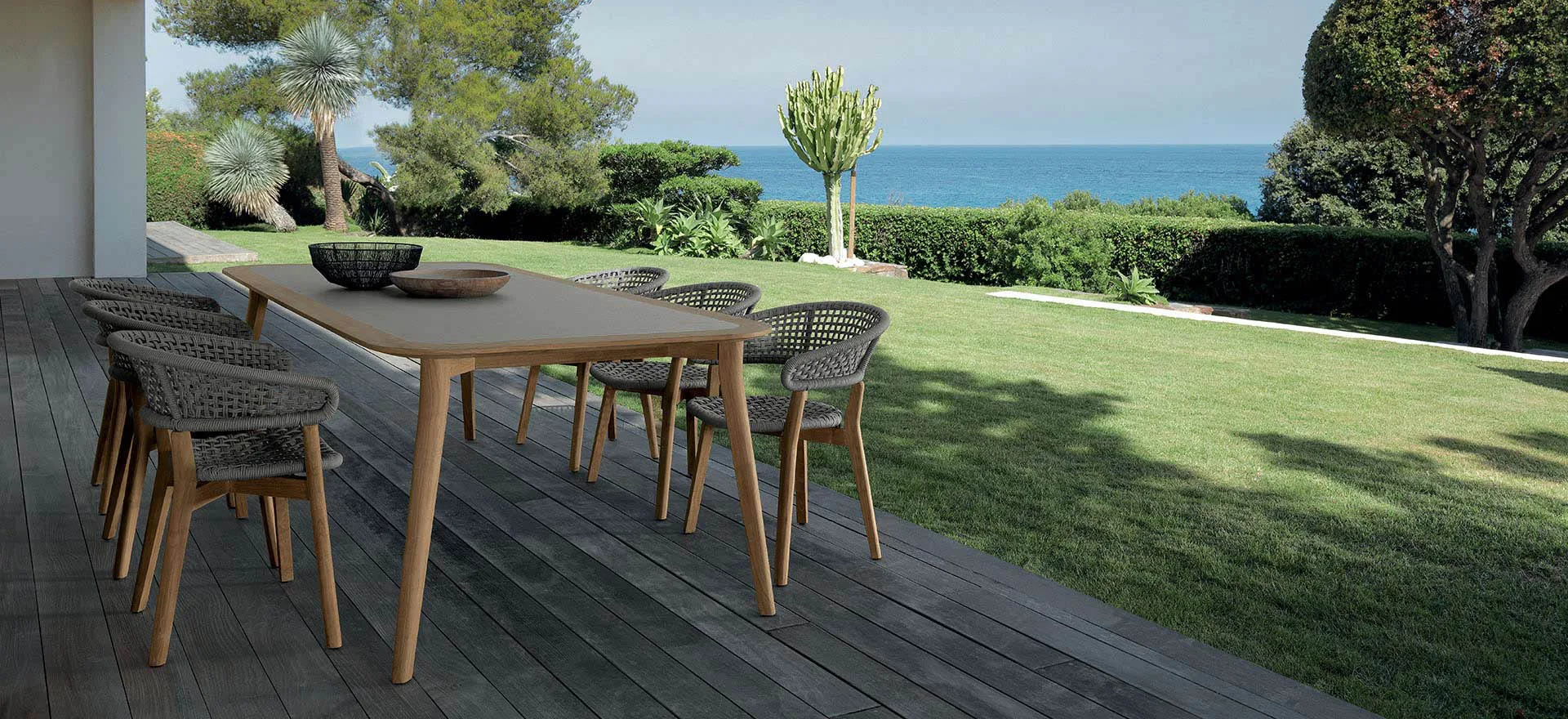
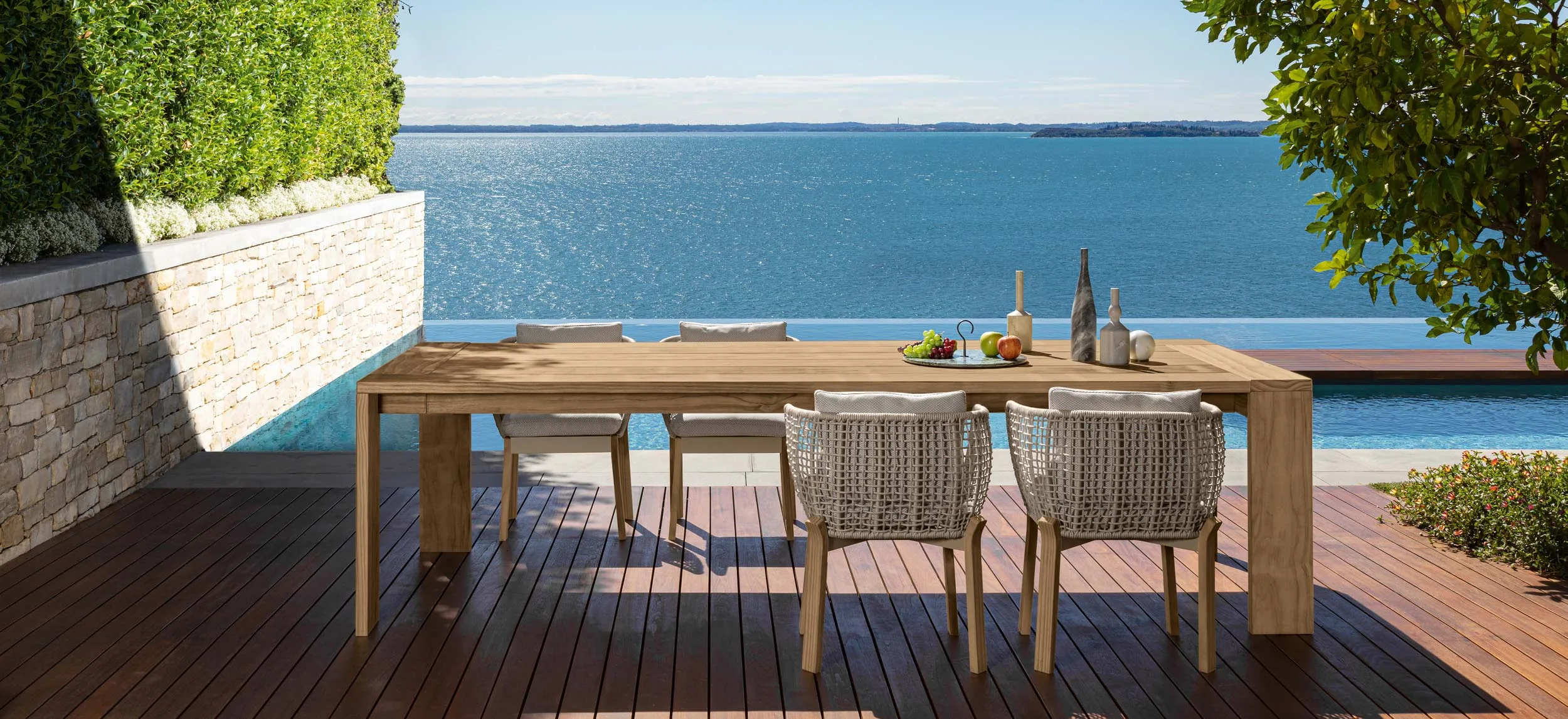
Accoya wood furniture starts as a softwood and ends up on terraces next to teak. This story explains the treatment behind it, how it weathers, and two Talenti collections built on it.
Accoya wood furniture has become a serious alternative to teak on terraces. Talenti, the outdoor furniture maker in Amelia, Umbria, uses accoya in several of its collections, and buyers ask us what the name means. The short answer: a softwood changed at the core by a chemical treatment so it can live outside.
Acetylation: softwood changed to the core
The factory's notes describe accoya as the result of more than 75 years of research. It begins as a softwood from sources the factory calls sustainable. A patented, non-toxic process called acetylation then modifies the wood through to its core. The point of the treatment is stability: the wood swells and shrinks less as the air turns wet or dry, and it lasts longer outside.
Talenti goes further and says the result matches, and in places beats, the best tropical hardwoods. That is the factory's claim, and we pass it on as such. The catalog adds a fact of its own: Talenti trusts accoya with some of its Icon collections, the line it builds its shows around.
At a glance
How softwood becomes accoya
-
75
years of research
behind the process, as the factory puts it
-
Start
Sustainably sourced softwood
the raw material
-
Process
Acetylation
patented, non-toxic, and it reaches the core
-
Result
Stable and durable
the wood moves less as humidity rises and falls
-
Finish
Honey or rosewood
the two Itaca base colors
Two collections in accoya
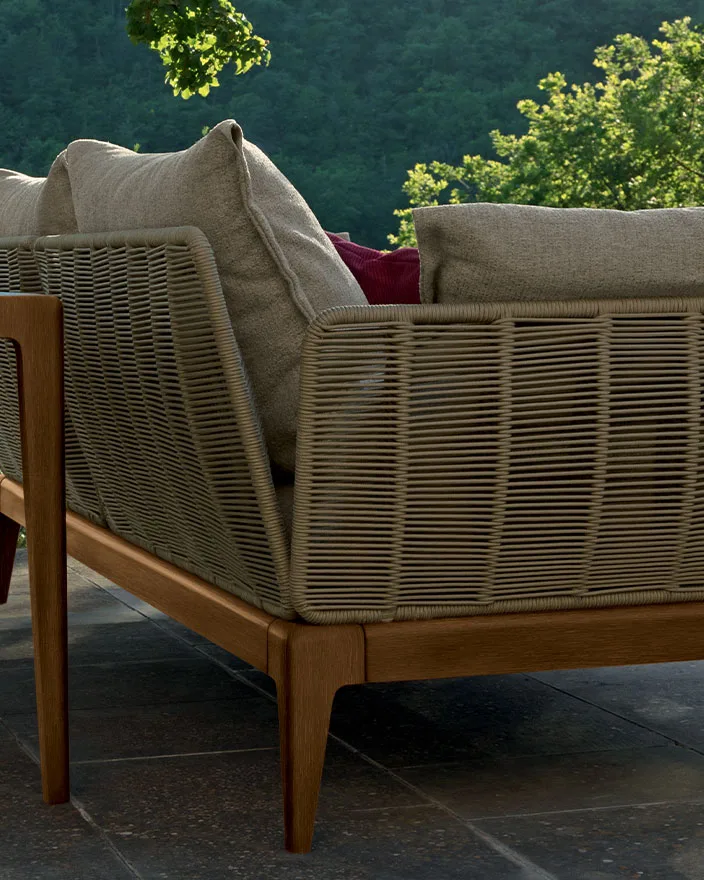
Talenti Argo Wood by Ludovica and Roberto Palomba starts from the idea of a wooden box. Wide side panels hold the cushions and make the seat deep, and a sledge base lifts the whole piece so the padding seems to float. The three seat sofa measures 240 by 95 cm with a seat height of 40 cm. The modular version adds pieces with a built in coffee table or a pouf at one end, and a separate coffee table runs 180 by 94 cm. See the Argo Wood collection.
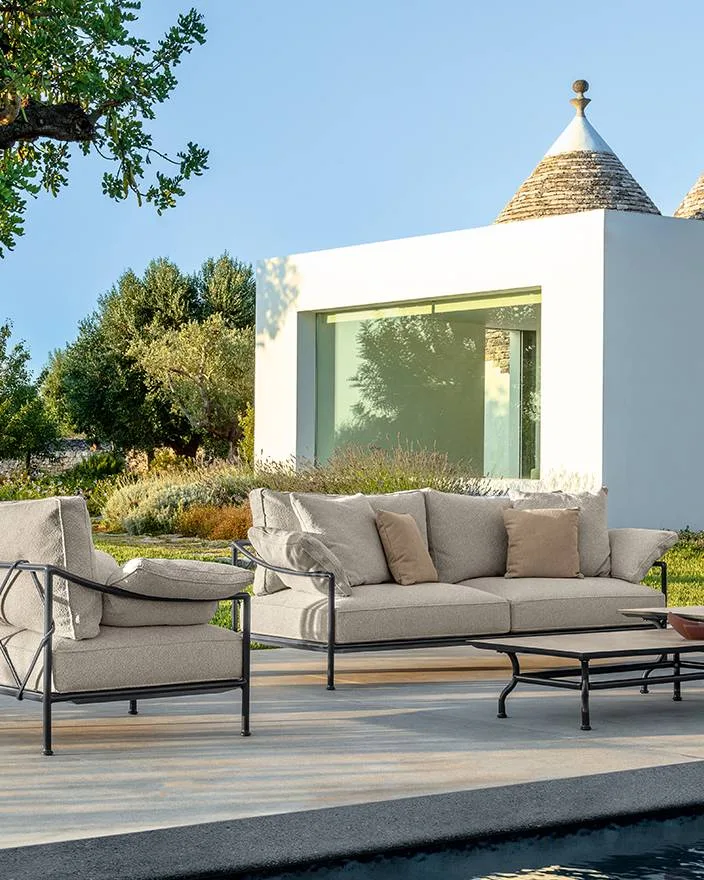
Talenti Itaca by Carlo Colombo borrows its name from the journey of Ulysses. The modules come in 100 and 150 cm widths and join or split like islands of an archipelago, so a sofa for a party becomes two sofas the next morning. The solid bases are accoya with rounded edges, in honey or rosewood. The low coffee tables, 15 cm high, carry sections of marble or travertine. See the Itaca collection.
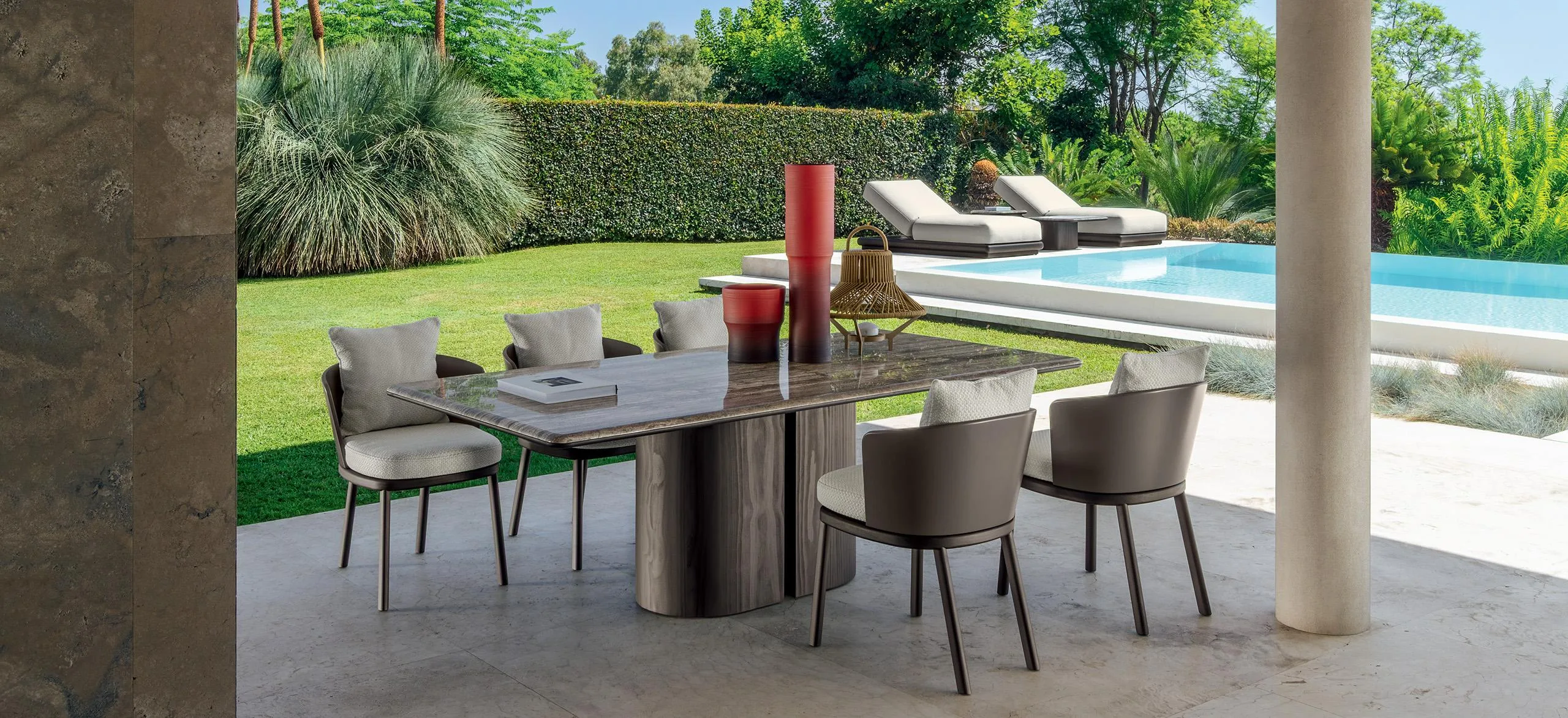
Talenti Itaca
Talenti Itaca by Carlo Colombo. The modules come together and split apart like islands, on accoya bases in honey or rosewood.
Weathering and care
Accoya is still wood, and Talenti's care notes for wood apply to it in full.
- Expect some variation in color, and fine cracks when humidity or temperature swings hard. The factory treats both as part of a natural material.
- Left without oil, the surface goes silver gray. A light sanding and a polish with a jute cloth bring the original tone back.
- Oil and food stains need fast action. Sand the spot and polish it with jute before the wood absorbs the stain.
- For a steady color, apply an oil-based protector from time to time.
The choice between silver and oiled is yours. The silver look suits a garden with stone and gravel. The oiled look suits a covered terrace next to a living room.
Accoya or teak?
Both woods work outdoors, and Talenti uses both. The differences show up in the details. Accoya comes from a managed softwood and relies on treatment for its stability. Teak brings its resistance with it, and a teak order needs the Lacey Act declaration of species and country of harvest. An accoya order needs one too, since it is wood, and we collect the data from the factory for each shipment.
The design often decides the question. If you like the deep box of Argo or the island modules of Itaca, you are choosing accoya. If you want rope wound through a teak frame, look at Cruise Teak or Moon Teak.
Compared
Accoya next to teak at Talenti
-
Accoya
- Starting material
- sustainably sourced softwood
- Treatment
- acetylation through to the core
- Factory claim
- matches or beats the best tropical hardwoods
- Left without oil
- silver gray patina
- Care
- oil-based protector, light sanding, jute cloth
- Talenti collections
- Argo Wood, Itaca, Allure, Karen, Cleosoft Wood
-
Teak
- Starting material
- tropical hardwood
- Treatment
- none named by the factory
- Factory claim
- resists temperature swings, water, humidity and salt
- Left without oil
- silver gray patina
- Care
- oil-based protector, light sanding, jute cloth
- Talenti collections
- Cruise Teak, Jun, Moon Teak, Parker, Thea
Settle the finish last
Wood tone changes with the light on your terrace, so settle the finish with the quote in hand. Send us the terrace plan and the Argo or Itaca pieces you like on the poster form at the foot of this page, and the Los Angeles desk answers with the modules that suit the plan, the finish choices for each, and a price that already counts freight and customs work.